
The Ghost in the Machine
I remember a time, not too long ago, when banking meant a deliberate act. You either walked into a physical branch or, as technology evolved, you consciously opened your bank’s mobile app or internet banking portal. It was a destination. You would check your balance, transfer funds, pay bills, and maybe apply for a fixed deposit. That app was a bank’s premium digital branch, a vital piece of branded real estate on your phone or laptop.
Today, our financial lives feel very different. For cash-on-delivery local kirana and grocery purchases, we scan a QR code with Google Pay or PhonePe. For online shopping, stored credit cards or integrated wallets handle the payment. The transaction is seamless, instant, and frictionless. But something critical is missing: The Bank.
Our actual bank, where the capital securely resides, has become a ghost in the machine. It is a logo that flashes for a split second, a name buried in a text success message. It has become a utility, a silent backend provider for a front-end experience owned entirely by someone else.
Welcome to the great Superapp Identity Crisis, the central strategic dilemma at the heart of modern retail banking. In the race to embrace the transaction boom, banks made a critical trade-off: they gained massive transaction volumes but sacrificed direct customer ownership. They spent millions building digital destinations, only to see their customers live, interact, and transact elsewhere.
This isn’t a question of product quality. It is about something far more uncomfortable: Are banks willingly sacrificing their customer relationship, their brand visibility, and their long-term relevance by deeply integrating into third-party ecosystems? Let’s unpack the mechanics of this shift.
The Convenience Trap: How We Got Here
The Unified Payments Interface (UPI) is, without a doubt, one of the world’s greatest financial technology success stories. Moving over 22 billion transactions a month, it has entirely democratized digital payments across India. Its open architecture was genius; it allowed agile third-party applications to build innovative, consumer-first experiences right on top of secure legacy banking infrastructure.
This structural shift led to two powerful industry phenomena:
- The Great Unbundling: The most frequent and engaging customer interaction, daily payments, was unbundled from the bank's proprietary mobile application.
- The Rise of the Superapp: Third-party tech players leveraged this opening to create feature-rich "superapps." They became the primary front door for everything from bill recharges to movie tickets and insurance, all quietly anchored by UPI.
For financial institutions, integrating with these superapps was an initial no-brainer. It offered immediate distribution to hundreds of millions of users and instant scale. This was the “Convenience Trap.” The customer acquisition was so rapid that few stopped to calculate the long-term erosion of the customer relationship.
The true cost is now clear: the bank is being completely disintermediated from its own customer base.
The Consequences of Becoming Invisible
When your banking application becomes just another dormant icon on a client’s smartphone, the direct business impact is severe:
- Commoditization: The bank becomes a "dumb pipe", a utility provider indistinguishable from its competitors. The brand relationship erodes, and the primary driver for a customer shifts entirely to price or interest rates, rather than experience or brand loyalty.
- Loss of Valuable Behavioral Data: The third-party superapp, not the financial institution, now tracks the customer’s spending habits, merchant preferences, and travel patterns. This transactional data is the lifeblood of modern finance, essential for precise credit scoring, predictive cross-selling, and risk management.
- Erosion of Cross-Sell Opportunities: How can a bank effectively cross-sell a home loan, a premium credit card, or an investment product if the customer never steps inside their digital storefront? The superapp instead becomes the prime real estate for offering contextual financial products, either their own or from a competitor paying for platform access.
Escaping the Invisible App Problem: The Strategic Playbook
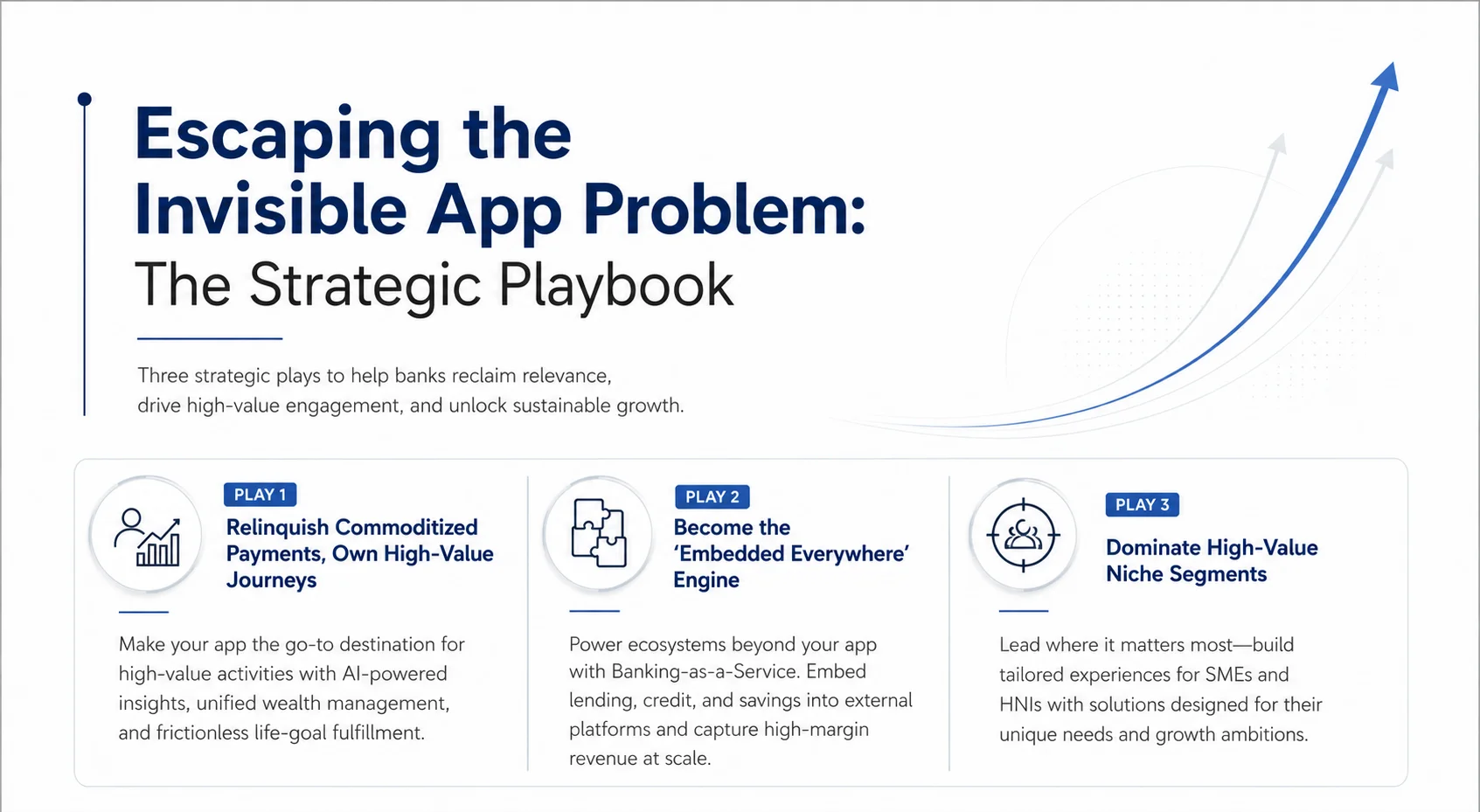
This is not a terminal diagnosis; it is an urgent call for a strategic pivot. While banks cannot easily “out-super-app” established big-tech ecosystems, they can rewrite the rules of digital engagement.
To reclaim market share and maximize customer lifetime value, forward-thinking institutions must adopt a modern, modular digital banking platform that allows them to deploy three powerful plays:
Play 1: Relinquish Commoditized Payments, Own High-Value Journeys
The goal here is to make the bank’s application the definitive destination for high-value activities that basic UPI apps cannot replicate. This means moving beyond passive balance checks and evolving into a proactive financial companion.
- Hyper-Personalized Insights: Harness AI to analyze a customer's total asset picture and offer automated, real-time advice: "You have a high idle cash balance; click here to sweep this into a short-term investment yield."
- Unified Wealth Management: Provide a beautiful, interactive cockpit for all of a customer's investments, mutual funds, and insurance policies—not just their core savings accounts.
- Frictionless Life-Goal Fulfillment: Create instant, one-click digital journeys for applying for home or auto loans, pre-approved based on historical data directly within your secure environment.
Play 2: Become the 'Embedded Everywhere' Engine
Instead of fighting an uphill battle to dominate the consumer front-end for every daily micro-transaction, embrace being the absolute best engine. This is the Banking-as-a-Service (BaaS) operational model.
By building out robust open banking infrastructure, you can embed your lending, credit, and high-yield savings products directly into external e-commerce sites, travel portals, and B2B platforms. Your brand might reside in the compliance fine print, but you successfully capture high-margin revenue from a vastly wider ecosystem, expanding far beyond the organic download limitations of your native app.
Play 3: Dominate High-Value Niche Segments
Rather than trying to be everything to everyone, customize your digital experience to become the undisputed market leader for specific, high-yield demographics.
- The Ultimate SME Operating System: Build a dedicated interface that solves holistic problems for small business owners, integrating digital invoicing, automated payroll, automated working capital loans, and real-time tax compliance.
- The Premier Wealth Cockpit: Create an elite, high-touch omnichannel banking experience tailored specifically for High-Net-Worth Individuals (HNIs), prioritizing deep portfolio analytics and seamless relationship manager connectivity.
- Frictionless Life-Goal Fulfillment: Create instant, one-click digital journeys for applying for home or auto loans, pre-approved based on historical data directly within your secure environment.
Debunking the Core Myths of Modern Banking
1. Myth: More UPI transactions are always good for banks.
Reality: While transaction volume is good, if it comes at the cost of direct customer relationship and future cross-sell opportunities, it’s a strategic loss. The fee income from a UPI transaction is minuscule compared to the potential profit from a loan or an investment product sold directly.
2. Myth: Banks should just build their own superapp to compete.
Reality: This is incredibly difficult. Banks are already creating new Apps in the name of tech refresh, new UI/UX, or to comply with new regulatory standards. The existing superapps like PhonePe, Google Pay, Paytm, etc. have a massive head start and a powerful network effect. A user won’t switch unless there are 10x better reasons to do so. A more viable strategy for banks is to focus on what they do uniquely well: providing deep, trust-based financial services.
3. Myth: This is only an Indian problem.
Reality: This is a global phenomenon. In other parts of the world, Big Tech companies (like Apple with its card) and fintechs are “unbundling” banking services in a similar way. The Indian experience with UPI is simply a more advanced and rapid version of this global trend.
Action Plan for Banking Leaders
For Product & Digital Experience Teams:
- Audit Metrics Honestly: Review your Monthly Active Users (MAU) and session times. If engagement is low, stop increasing your marketing spend on the same interface. Re-evaluate the underlying user journey.
- Isolate Key Journeys: Identify 2 or 3 high-margin user journeys—such as automated digital onboarding or wealth management—and optimize them until they are completely frictionless.
- Utilize Low-Code Agility: Transition away from rigid monolithic software frameworks. Implement component-driven architecture to rapidly launch, test, and iterate new customer-facing features without altering your core banking systems.
For Executive Leadership & Strategy:
- Reframe Success Metrics: Shift corporate KPIs away from raw transaction volumes. Prioritize relationship depth metrics: products per customer, cross-sell conversion rates, wallet share, and digital application retention.
- Focus on High-Impact Life Moments: Accept that consumer habits for daily micro-payments have shifted. Focus your technical resources on capturing major financial milestones: purchasing a home, scaling a business, or structuring long-term retirement portfolios.
From Utility to Indispensable Financial Partner
The surge of third-party platforms does not pose an existential threat to the survival of traditional banks; rather, it poses a direct threat to their brand relevance. Operating strictly as the plumbing, the invisible utility that moves capital back and forth, is a low-margin, low-differentiation business model.
The future belongs to institutions that pivot from chasing the transaction to securing the customer relationship. By building hyper-personalized, segment-aware digital journeys, banks can transform their mobile apps from an overlooked icon into an indispensable financial anchor.
Your institution doesn’t need to be the app your customers open ten times a day for micro-purchases. But it must be the definitive platform they trust when it matters most.